
A determination that a substance is not scheduled under the Controlled Substances Act tends to be read as a verdict on whether that substance is addictive. It is not a verdict of that kind. Scheduling is an administrative classification made by one agency, under one statute, to answer a narrow question — and the distance between that question and the clinical questions a prescriber actually asks is wider than the shorthand suggests.
That gap matters to anyone assessing an analgesic development program, because scheduling status is one of the few regulatory facts about an early-stage candidate that is legible to non-specialists. Legibility invites over-reading. What follows sets out what a scheduling determination establishes, what it does not, and how the March 2026 determination that PVP Labs reports for its lead investigational candidate should be read within those limits.
What the DEA determined
PVP Labs reports that in March 2026, the U.S. Drug Enforcement Administration determined that lumekefamide, an investigational candidate, is not a controlled substance or a listed chemical under the Controlled Substances Act. This is an administrative determination regarding abuse potential based on the data available to the agency; it is not a finding of safety or efficacy by the FDA, and it does not constitute a clinical conclusion about dependence liability. The underlying correspondence has not been made public, and no primary agency document has been located.
Two terms in that statement carry statutory meaning. The Controlled Substances Act (CSA) is the federal statute that places substances with recognized abuse potential into five schedules, each carrying escalating manufacturing, distribution, recordkeeping and prescribing controls. A listed chemical is a separate statutory category covering precursor and essential chemicals used in the manufacture of controlled substances, regulated under a distinct framework.
Investigational status. Taphalgin® (lumekefamide) is an investigational product. It has not been approved by the U.S. Food and Drug Administration or the European Medicines Agency, and its safety and efficacy have not been established for any use in these jurisdictions. This content is provided for scientific and informational purposes only. It is not medical advice, not an offer to sell, and not a solicitation of any product.
What a scheduling determination is — briefly
Scheduling authority sits with the Attorney General, delegated to the DEA, under 21 U.S.C. §§ 811–812. The statute directs that placement decisions consider a defined set of factors, among them a substance’s actual or relative potential for abuse, its known pharmacological effect, the state of current scientific knowledge, its history and current pattern of abuse, and the risk it poses to public health.
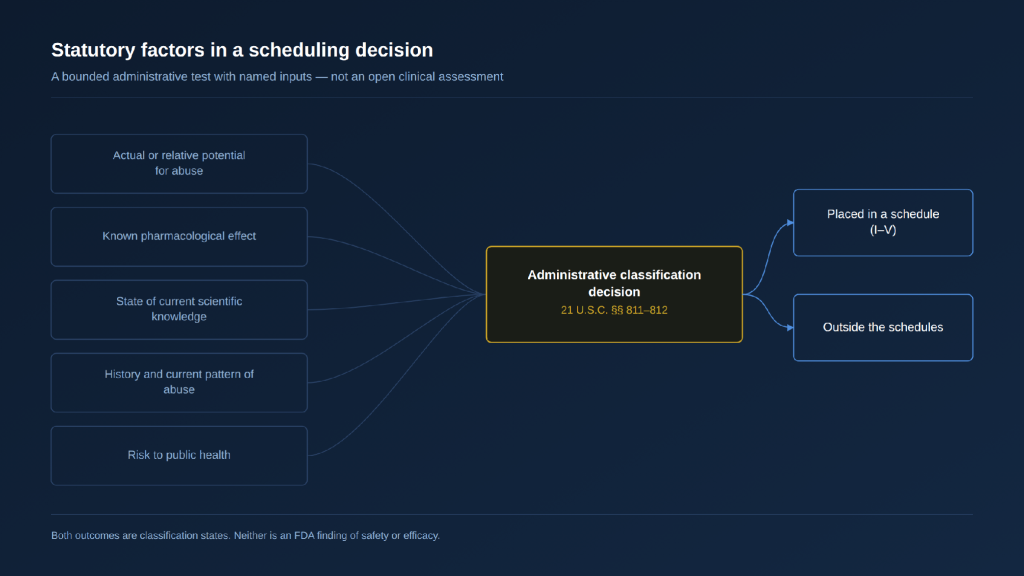
Abuse potential, in this regulatory sense, refers to the likelihood that a substance will be taken outside medical supervision for its psychoactive effect. The term is narrower than the lay word “addictiveness,” which bundles together reinforcement, tolerance, physical dependence and compulsive use — properties that are assessed separately and by different methods.
A determination that a substance falls outside the schedules is therefore a statement about statutory classification on the evidence before the agency. The process is administrative rather than clinical, and it is not a review of therapeutic performance.
The three things it does not establish
It is not an FDA finding of safety
Safety determinations for drug products are made by the FDA, under the Federal Food, Drug, and Cosmetic Act, through review of a marketing application supported by the full nonclinical and clinical dossier. The DEA does not conduct that review and does not issue that finding.
For any candidate that has not completed FDA review, safety has not been established — and a scheduling determination does not alter that position in either direction. This is the most common misreading of news of this kind, and the one most likely to be repeated in secondary coverage.
It is not a finding of efficacy
Therapeutic effect falls entirely outside the scope of a scheduling determination. Whether a candidate produces clinically meaningful analgesia, in which populations, at what onset and for what duration, is established through adequate and well-controlled trials assessed by FDA reviewers. Nothing in a CSA classification speaks to it.
It is not a clinical conclusion about dependence liability
This is the distinction that matters most to clinicians, and it is the one the shorthand collapses. Dependence liability is characterized through dedicated study: human abuse potential trials, in which a substance’s subjective effects are compared against a known positive control in experienced recreational users; physical dependence and withdrawal assessment; and, after approval, post-marketing surveillance. FDA’s 2017 guidance on the assessment of abuse potential of drugs sets out that this work is a component of the marketing application, evaluated alongside the rest of the safety package — not a product of the scheduling process.
The mechanistic context makes the distinction sharper rather than softer. The company describes the investigational candidate lumekefamide as acting through selective μ1-opioid receptor agonism combined with calcium-channel modulation — that is, as an opioid receptor agonist with a differentiated receptor profile, not as a compound outside the opioid class. For any agonist at the μ-opioid receptor, dependence liability is a live scientific question that is answered by data, not by classification status.
For a candidate still in development, that characterization is by definition incomplete. Stating so is not a hedge; it is the accurate description of where the evidence stands.
Where this sits in the development pathway
Scheduling classification and marketing authorization proceed under separate statutes and separate agencies; neither predicts the other.
Scheduling status and marketing authorization are determined through separate processes, by different agencies, against different statutory tests. Neither predicts the other. A candidate can be approved and subsequently scheduled; a scheduled substance can be rescheduled or descheduled as evidence accumulates; and a substance outside the schedules can be placed into them if new data support it.
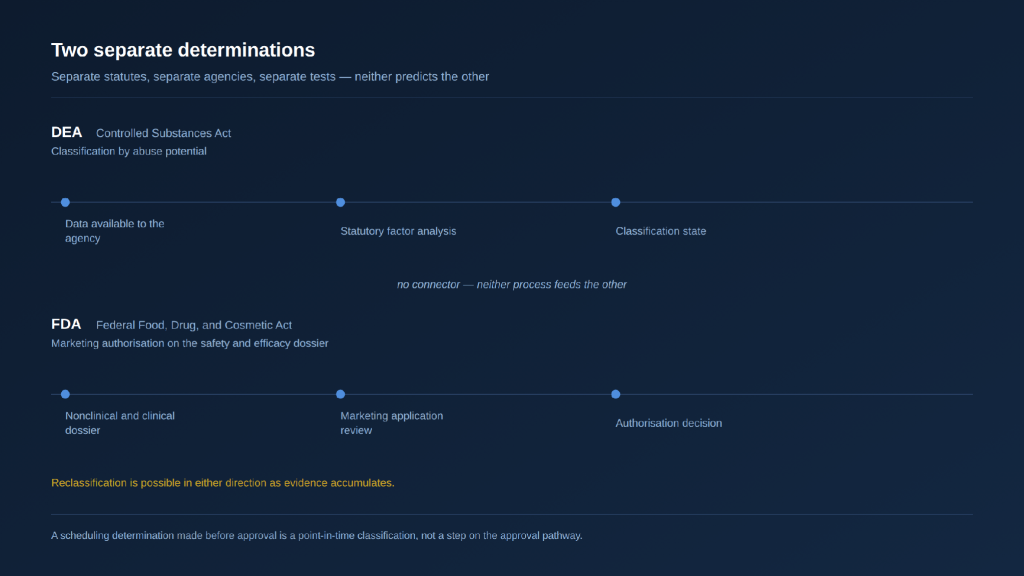
A determination made before approval is therefore a point-in-time classification, not a completed step on a regulatory pathway toward marketing authorization. It should not be read as an indicator of review status, review outcome, or timing.
What would change this picture
Scheduling determinations rest on the data available to the agency at the time they are made, which is an explicit feature of the statutory scheme rather than a limitation of any particular decision. Several categories of subsequent evidence could support a different assessment: results from human abuse potential studies; physical dependence and withdrawal findings from repeat-dose exposure; signals arising in post-approval surveillance, should a product reach the market; or new pharmacological data refining the understanding of receptor-level behavior.
For a μ-opioid receptor agonist specifically, the informative question is not whether a substance is currently classified, but what the abuse-potential data package contains, how it was generated, and in which populations. That is the question a scientific or investment reader should be asking of any analgesic program describing a differentiated opioid mechanism — including this one. The methodological question it leaves open is a substantive one: what constitutes a sufficient dependence-liability characterization for a receptor-subtype-selective agonist.
Sources
- Controlled Substances Act — scheduling authority and criteria. 21 U.S.C. § 811 and 21 U.S.C. § 812. (Regulatory)
- Controlled Substances Act — definitions, including “listed chemical.” 21 U.S.C. § 802. (Regulatory)
- Federal Food, Drug, and Cosmetic Act — approval of new drug applications. 21 U.S.C. § 355. (Regulatory)
- U.S. Drug Enforcement Administration, Diversion Control Division — schedules of controlled substances and scheduling actions. (Regulatory)
- FDA, Assessment of Abuse Potential of Drugs, Guidance for Industry, January 2017. (Regulatory)
- PVP Labs announcement of the DEA determination, April 2026. (Company source — statements attributed to the company throughout and not restated as independent fact. Cited without a hyperlink; see the linking note.)
PVP Labs is a Singapore-based peptide biotechnology company developing peptide therapeutics across analgesia, antiviral and tissue-repair indications.