
Provisional data from the CDC’s National Center for Health Statistics put US drug overdose deaths at an estimated 69,973 in 2025, down almost 14% from the 81,313 estimated for 2024 — a third consecutive annual decline. Opioid-involved deaths fell from an estimated 55,296 to 44,564 across the same period. Both figures are provisional and remain subject to revision as records are finalised.
The decline is real, and the reasons for it are actively debated. What it is not is a change in what opioid molecules do. Almost the entire public conversation about this crisis concerns prescribing behaviour, regulatory control and illicit supply — variables that govern how often a drug reaches a person. A separate question governs what happens once it does, and that question is pharmacological. It has not been answered, and it is not the kind of question policy can answer.
What prescribing-side intervention has and has not changed
The prescribing-side effort has produced measurable results, and it is worth being specific about them rather than gesturing at them. In a retrospective cohort of 989,354 opioid-naïve, privately insured adults undergoing 17 common surgical procedures between 2013 and 2021, the size of the initial postoperative opioid prescription fell from 282 to 164 oral morphine equivalents (mg OME). Refills within 30 days fell from 24.6% to 13.6%. New persistent opioid use — continued use in a patient who had none before the procedure — fell from 2.7% to 1.1% (Luby et al., Annals of Surgery, 2025).
That is a substantial change in clinical practice over eight years, in one insured population, for one category of procedure. It should not be generalised beyond that cohort, and the study does not establish what caused the change.
It also has a structural limit. Every one of those interventions works by reducing the number of exposures. None of them alters the drug’s behaviour in the patient who is still exposed — the patient with a fractured femur, a thoracotomy, or breakthrough cancer pain, for whom a potent analgesic remains the clinically indicated option. For that patient, the opioid analgesics that remain the mainstay carry substantially the same receptor-level liability they carried in 1996. Reducing the denominator is real progress. It is not the same as changing the drug.
Analgesia and harm share a receptor
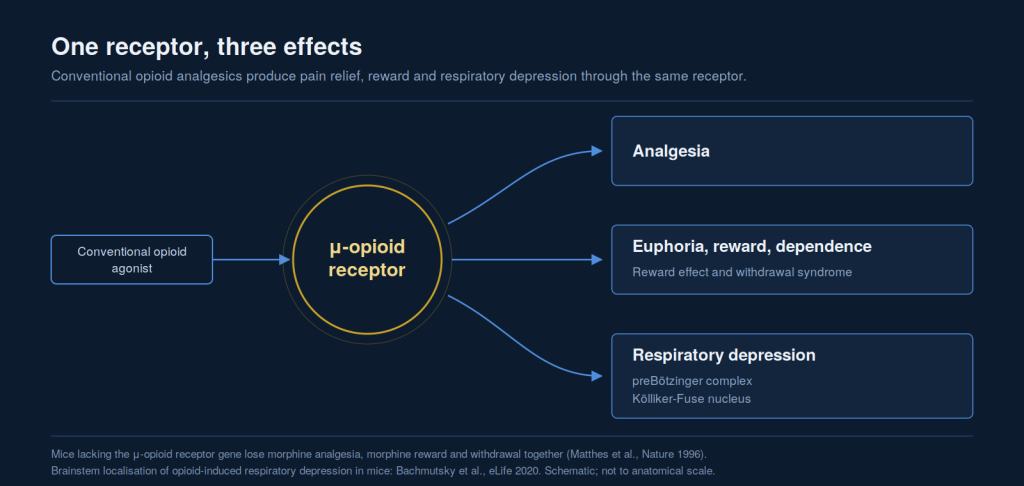
The reason the risk profile has not moved is not a failure of effort. It is a structural feature of how these drugs work.
The μ-opioid receptor is the G-protein-coupled receptor that mediates the analgesic action of morphine and of every conventional opioid analgesic in clinical use. It is also the receptor through which those drugs produce euphoria, dependence and respiratory depression.
This is not an inference from correlation. Mice engineered to lack the μ-opioid receptor gene lose morphine analgesia, lose the rewarding effect of morphine, and show no withdrawal syndrome — all three disappear together with the single receptor (Matthes et al., Nature, 1996). Remove the target and you remove the therapy and the liability at the same time.
Respiratory depression, the effect that makes overdose lethal, is anatomically localised even though it is pharmacologically the same receptor. Work in mice has traced opioid-induced respiratory depression principally to two small brainstem regions: the preBötzinger complex, a cluster of neurons that generates the inspiratory rhythm, and the Kölliker-Fuse nucleus, a pontine region involved in the timing and patterning of breathing (Bachmutsky et al., eLife, 2020).
The implication is uncomfortable and worth stating plainly. Opioid respiratory depression is not an off-target effect, a contaminant, or a formulation artefact — the categories of problem that medicinal chemistry is generally good at removing. It is the intended on-target effect, occurring at an unintended anatomical location. A molecule that engages the μ-opioid receptor to relieve pain engages the same receptor in the brainstem, because it is the same receptor.
Whether the two can be pharmacologically separated — by receptor subtype, by signalling pathway, by intrinsic efficacy, or by anatomical restriction of the drug’s distribution — is an open research question rather than a solved engineering problem. It has been an open question for decades.
The most developed attempt, and what happened to it
The field’s most advanced attempt to separate these effects has been substantially reinterpreted over the past six years, and the current state of the evidence is contested. That is the honest summary, and the detail is instructive for anyone assessing analgesia programmes.
The hypothesis was biased agonism. Mice lacking β-arrestin-2 — a protein that couples to activated receptors and was thought to mediate the adverse arm of μ-opioid signalling — showed potentiated morphine analgesia (Bohn et al., Science, 1999) and, in later work from the same group, reduced respiratory depression and constipation (Raehal et al., Journal of Pharmacology and Experimental Therapeutics, 2005). If analgesia ran through G-protein signalling and harm ran through arrestin, a ligand that engaged one pathway and not the other would be a genuinely differentiated opioid. A generation of G-protein-biased candidates was designed on that premise.
The premise did not survive scrutiny intact. A multi-laboratory study did not reproduce the respiratory findings in β-arrestin-2 knockout mice (Kliewer et al., British Journal of Pharmacology, 2020). Mice engineered with phosphorylation-deficient, G-protein-biased μ-opioid receptors showed enhanced analgesia and diminished tolerance, while respiratory depression and constipation were unchanged or exacerbated — not the reduction the hypothesis predicted (Kliewer et al., Nature Communications, 2019).
Testing the biased candidates side by side, Gillis et al. (Science Signaling, 2020) found that their therapeutic indices correlated with intrinsic efficacy at the receptor and not with bias factor, concluding that the compounds behaved as low-efficacy partial agonists rather than as pathway-selective ligands. A review of the controversy is available in Azevedo Neto et al. (Molecules, 2020).
That reinterpretation is itself disputed. Stahl and Bohn (Biochemistry, 2022) argue that low intrinsic efficacy alone does not account for the observed profiles of these agonists. The question of whether the μ-opioid receptor can be engaged in a way that dissociates analgesia from respiratory depression is genuinely unresolved in the primary literature, and a reader should treat any confident answer to it — in either direction — as running ahead of the evidence.
What “differentiated analgesia” means as a goal
Because the term is used loosely, it is worth defining against a requirement rather than against a mechanism. Differentiated analgesia would mean clinically meaningful pain relief at doses that leave respiratory drive and reward circuitry substantially unengaged, demonstrated in humans, in adequately powered trials, with the separation shown rather than inferred from receptor-level assays. Nothing less than that clears the bar, and mechanistic plausibility has repeatedly failed to predict the clinical result in this field.
Of the directions below, one has so far produced an approved medicine and the others have not; each carries an unresolved problem. One is to leave the opioid receptor entirely: the FDA approved suzetrigine, a selective NaV1.8 sodium-channel inhibitor, for moderate-to-severe acute pain on 30 January 2025 — the first drug approved in that class — and how far it will substitute for opioids in practice is still being established. A second is to modify engagement at the receptor itself, through intrinsic efficacy, signalling bias, or subtype selectivity, where the evidence remains as contested as described above. A third is peptide chemistry, which occupies different design space from small molecules, has likewise not demonstrated the separation described above in humans, and carries its own constraints in delivery, stability and manufacturing cost.
The scale of public investment reflects how unsolved the problem is. NIH’s HEAL Initiative funds a pain therapeutics development programme directed at analgesics that act outside opioid pathways and do not carry opioid abuse liability, supporting candidates from medicinal chemistry through Phase I (NINDS, Pain Therapeutics Development Program). Governments do not build translational infrastructure for problems the private sector has already solved.
Why the distinction matters
The practical value of separating the policy problem from the receptor problem is that it changes the questions worth asking.
For a clinician, it explains why multimodal protocols and prescribing limits, however well implemented, do not resolve the situation of the patient with severe acute pain. For an investor or licensing partner assessing an analgesia programme, it suggests a sharper line of enquiry than the mechanism slide: what does the candidate do at the receptor, at what intrinsic efficacy, and has the claimed separation been demonstrated in humans rather than modelled from binding data? The biased-agonism episode is a useful calibration — a mechanistically elegant hypothesis, widely adopted, that produced approved medicines and a decade of argument about why they work.
Overdose mortality is falling. The molecular basis of the harm is unchanged. Those two facts are compatible, and holding both of them at once is the beginning of a serious conversation about what the next generation of analgesics would actually have to demonstrate.
Sources
- CDC / National Center for Health Statistics. U.S. Overdose Deaths Decrease for Third Consecutive Year in 2025. 13 May 2026. (Provisional data, subject to revision.)
- Luby AO, Alessio-Bilowus D, Hu HM, Brummett CM, Waljee JF, Bicket MC. Trends in Opioid Prescribing and New Persistent Opioid Use After Surgery in the United States. Annals of Surgery 2025;281(3):347–352.
- Matthes HWD, et al. Loss of morphine-induced analgesia, reward effect and withdrawal symptoms in mice lacking the μ-opioid-receptor gene. Nature 1996;383:819–823.
- Bachmutsky I, et al. Opioids depress breathing through two small brainstem sites. eLife 2020;9:e52694.
- Bohn LM, Lefkowitz RJ, Gainetdinov RR, Peppel K, Caron MG, Lin FT. Enhanced morphine analgesia in mice lacking beta-arrestin 2. Science 1999;286(5449):2495–2498.
- Raehal KM, Walker JKL, Bohn LM. Morphine side effects in β-arrestin 2 knockout mice. Journal of Pharmacology and Experimental Therapeutics 2005;314(3):1195–1201.
- Kliewer A, et al. Morphine-induced respiratory depression is independent of β-arrestin2 signalling. British Journal of Pharmacology 2020. doi:10.1111/bph.15004.
- Kliewer A, et al. Phosphorylation-deficient G-protein-biased μ-opioid receptors improve analgesia and diminish tolerance but worsen opioid side effects. Nature Communications 2019;10:367.
- Gillis A, et al. Low intrinsic efficacy for G protein activation can explain the improved side effect profiles of new opioid agonists. Science Signaling 2020;13:eaaz3140.
- Azevedo Neto J, et al. Biased versus Partial Agonism in the Search for Safer Opioid Analgesics. Molecules 2020;25(17):3870.
- Stahl EL, Bohn LM. Low Intrinsic Efficacy Alone Cannot Explain the Improved Side Effect Profiles of New Opioid Agonists. Biochemistry 2022. doi:10.1021/acs.biochem.1c00466.
- National Institute of Neurological Disorders and Stroke. Pain Therapeutics Development Program (NIH HEAL Initiative).
- US Food and Drug Administration. FDA Approves Novel Non-Opioid Treatment for Moderate to Severe Acute Pain. Press announcement, 30 January 2025.
PVP Labs is a Singapore-based peptide biotechnology company developing peptide therapeutics across analgesia, antiviral and tissue-repair indications.
This content is provided for scientific and informational purposes only. It is not medical advice, not an offer to sell, and not a solicitation of any product. No PVP Labs development candidate is discussed in this article.